


It's been hard to believe it's December with the warm weather we've been having, but the plant and animal world have slowed down on schedule. I'm hoping for a little cold weather to make us appreciate our family trip to Florida -- but not so much that it keeps everyone inside! Here are some of the things we like to look for in the greyer world of winter.
When the cold whether does come, I tend to get grumpy about it. It's good to remind myself of the junco -- who comes down from Canada to enjoy our (relatively) balmy winter. At least we're not in Canada, I say. Plus, they're cute little birds.
Meanwhile, the squirrels have built their nests for the winter and are hunkering down. Cute alert: this post includes BBC footage of baby squirrels.
The garlands of greenery went up in my office building last week, just like clockwork. But the tradition of bringing holly inside at this time of year pre-dates Christmas. And there's plenty to celebrate about these berries -- and the birds they attract -- even if you're not decking the halls.
Christmas ferns were also once used as holiday decorations, for the same reason -- they stay green all winter.
While you're out and about enjoying the winter sunshine, try your hand at identifying some trees. It's a lot harder without the leaves! We made a quick guide to ten winter trees that often catch our eye.
Your breath is often visible around this time of year. Look at it as a measure of temperature and humidity, or enjoy the visible reminder of the breath of all life.
And, for those of you who tend to feel a little house-bound as it gets colder and colder outside, last year we also wrote a Southerner's Guide to Staying Warm Outside in the Winter. Now get out there and explore!
Most Popular Posts
-
Photo credit: ilkerender Last year we listed places to swim near DC and places to rent a canoe near DC . Today we return to complete the s...
-
Summer calls out for being on the water. We've found more than a dozen locations where you can rent a canoe or kayak in the Washington, ...
-
What a lovely break in the heat we're having. Here are some things to keep an eye out for in August. Links are to previous LOOK FOR post...
-
This spring has been cold and a little slow, like last year. Morels , in particular, are just starting to show up. Below are all the things ...
-
The Jack in the pulpits are starting to unfurl right now. I've always loved these flowers, showy in their design rather than their color...
-
I've been distracted from the Natural Capital but I haven't totally forgotten about you guys...Here are some of the other things we ...
-
This time last year, the wood frogs were out and had already laid their eggs. As of this morning, the pond where we always find them was com...
-
Our monthly roundup of things to look for this month: Photo credit: InspiredinDesMoines I originally wrote about bald eagles for t...
-
Two of the things we love best about living in the DC metro area are the public transportation system, and the parks. And so, one of our mai...
-
If I had to name my biggest frustration with the nature around DC, the lack of good swimming holes might top the list. Until 7th grade I liv...
Showing posts with label December. Show all posts
Showing posts with label December. Show all posts
Sunday, December 2, 2012


Friday, December 9, 2011
Things to look for in December
Hello dear readers, we've been slowing down the rate of posts here at the Natural Capital due to...well, life. And it's about to get a whole lot slower as we leave town, first to visit family in Florida, and then to visit the coral reefs, jungles, and cloud forests of Honduras for a big chunk of January. We've scheduled a few posts to show up here automatically while we're gone, just so you don't think we've forgotten about you! In the meantime, there's plenty to explore for those of you staying up here in colder climes.
As I get grumpy about cold weather, it's good to remind myself of the junco -- who comes down from Canada to enjoy our (relatively) balmy winter. At least we're not in Canada, I say. Plus, they're cute little birds.
Meanwhile, the squirrels have built their nests for the winter and are hunkering down. Cute alert: this post includes BBC footage of baby squirrels.
The garlands of greenery went up in my office building last week, just like clockwork. But the tradition of bringing holly inside at this time of year pre-dates Christmas. And there's plenty to celebrate about these berries -- and the birds they attract -- even if you're not decking the halls.
Christmas ferns were also once used as holiday decorations, for the same reason -- they stay green all winter.
While you're out and about enjoying the winter sunshine, try your hand at identifying some trees. It's a lot harder without the leaves! We made a quick guide to ten winter trees that often catch our eye.
Your breath is often visible around this time of year. Look at it as a measure of temperature and humidity, or enjoy the visible reminder of the breath of all life.
And, for those of you who tend to feel a little house-bound as it gets colder and colder outside, last year we also wrote a Southerner's Guide to Staying Warm Outside in the Winter. Now get out there and explore!
As I get grumpy about cold weather, it's good to remind myself of the junco -- who comes down from Canada to enjoy our (relatively) balmy winter. At least we're not in Canada, I say. Plus, they're cute little birds.
Meanwhile, the squirrels have built their nests for the winter and are hunkering down. Cute alert: this post includes BBC footage of baby squirrels.
The garlands of greenery went up in my office building last week, just like clockwork. But the tradition of bringing holly inside at this time of year pre-dates Christmas. And there's plenty to celebrate about these berries -- and the birds they attract -- even if you're not decking the halls.
Christmas ferns were also once used as holiday decorations, for the same reason -- they stay green all winter.
While you're out and about enjoying the winter sunshine, try your hand at identifying some trees. It's a lot harder without the leaves! We made a quick guide to ten winter trees that often catch our eye.
Your breath is often visible around this time of year. Look at it as a measure of temperature and humidity, or enjoy the visible reminder of the breath of all life.
And, for those of you who tend to feel a little house-bound as it gets colder and colder outside, last year we also wrote a Southerner's Guide to Staying Warm Outside in the Winter. Now get out there and explore!
Friday, January 21, 2011
LOOK FOR: Footprints in the Snow
Winter is the time of year here in the mid-Atlantic where things become more visible: the lay of the land, the structures of the trees, and the tracks of mammals and birds.

When I was a kid, we had invisible markers that we could use to write a secret message a piece of paper. The only way to reveal the message was using another special marker that when you drew over what was scribbled, the message became visible.
A light coat of snow accomplishes a similar phenomenon. All around us, creatures are moving about making invisible marks. Many are secretive, shying away from humans or making their rounds in the early morning. When I take a walk in the woods, I have no clue that a fox uses the same path during its early morning hunts. But, the snow reveals it all. You can even tell when the fox was walking, trotting, or running by the pattern its prints leave in the snow.
So, get out before the snow gets too trampled and follow a trail. All will be revealed!
Here are some different tracks that you may encounter in the snow. Once you learn them, you can find them year-round in muddy areas along streams or puddles.


Fox tracks crossing the Northwest Branch
A light coat of snow accomplishes a similar phenomenon. All around us, creatures are moving about making invisible marks. Many are secretive, shying away from humans or making their rounds in the early morning. When I take a walk in the woods, I have no clue that a fox uses the same path during its early morning hunts. But, the snow reveals it all. You can even tell when the fox was walking, trotting, or running by the pattern its prints leave in the snow.
So, get out before the snow gets too trampled and follow a trail. All will be revealed!
Here are some different tracks that you may encounter in the snow. Once you learn them, you can find them year-round in muddy areas along streams or puddles.
Friday, December 17, 2010
LOOK FOR: Christmas Fern
There are 12,000 species of ferns in the world, but I can only identify about five of them without looking them up. Christmas fern (Polystichum acrostichoides) is one of the easiest.
At this time of year, one of the most notable things about Christmas fern is that it is one of just a few ferns that grow in our area that is evergreen. In fact, people used to harvest the leaves for use in wreaths and other Christmas decorations -- thus the common name.
But you can easily identify Christmas fern at other times of year, too. Look at the shape of the leaflets: they're bent into a J shape near where the leaflet joins the stem. Think of them as little Christmas stockings, and you will always recognize the Christmas fern!
In the wild: Christmas fern is common in our local woods, especially along streams and on hillsides. Its green should stand out at this time of year.
In your yard: These are a great option to get a little year-round green in a shady spot that doesn't get too dry. Christmas ferns are widely available at local nurseries, but they aren't cheap -- ferns are hard to propagate. They can be divided if you've got a friend with a healthy clump: do it in the spring when they're sending up new shoots, and make sure you get several fiddleheads per division.
At this time of year, one of the most notable things about Christmas fern is that it is one of just a few ferns that grow in our area that is evergreen. In fact, people used to harvest the leaves for use in wreaths and other Christmas decorations -- thus the common name.

But you can easily identify Christmas fern at other times of year, too. Look at the shape of the leaflets: they're bent into a J shape near where the leaflet joins the stem. Think of them as little Christmas stockings, and you will always recognize the Christmas fern!
In the wild: Christmas fern is common in our local woods, especially along streams and on hillsides. Its green should stand out at this time of year.
In your yard: These are a great option to get a little year-round green in a shady spot that doesn't get too dry. Christmas ferns are widely available at local nurseries, but they aren't cheap -- ferns are hard to propagate. They can be divided if you've got a friend with a healthy clump: do it in the spring when they're sending up new shoots, and make sure you get several fiddleheads per division.

Tuesday, December 14, 2010
A Southerner's Guide to Staying Warm Outdoors in Winter
DC is in a funny middle ground, geographically speaking. Is it the northern edge of the south, or the southern edge of the north? Having spent good chunks of my life in much warmer climes, DC is about as far north as I'm willing to live. I'm just not a big fan of cold weather. (If DC is as far south as you're willing to live, this post might not be for you.)
I am a big fan of being outdoors, so I try not to let the cold keep me inside all winter. Every year as the thermometer takes a nose-dive I have to remind myself of all the coping strategies I've come up with:
>> Do you have tricks for staying warm outside? Leave a comment below.
Stay dry. Moisture is a killer in cold temperatures. This is the number one rule, underlying several of the others on this list.
Removable layers on top. If I'm going to be moving around, I know I'll stay drier (and therefore possibly even warmer) if I can easily take off a layer once I warm up.
Long johns on the bottom. My discovery of long underwear after leaving Florida for college changed my experience of winter from agony to a reluctant truce. I've got three different weights (silk, polypro, and fleece) so I can aim for just the right level of insulation. For me, this is a below-the-waist solution: most long john tops actually make me too hot.
Learn to live with hat-head. Every day I cringe on my way to the metro when I see people walking around without a hat in this weather. How do they do it? Mom was only partially right: it turns out your head is no more efficient than any other exposed part of your body at losing heat. But if it's the only part of your body that's uncovered, you'll lose a lot of heat that way. And your head is more sensitive to cold than other body parts. I'd rather go with a hat and lighter clothing than the other way around.

Mittens are warmer than gloves. Somehow, pooling the body heat from all four digits makes a huge difference. This is another item I have to take off once I get moving. But it's so nice on a cold winter day to have warm hands!
Europeans know how to tie a scarf. You do wear a scarf, don't you? I just learned this trick last year: fold your scarf in half, put the folded scarf around your neck, then tuck the loose ends through the fold. This is much warmer than just wrapping: it seems to stay a lot snugger on my neck.
Keep moving. Inside your layers, you'll generate a good amount of heat if you keep moving. But there's a corrollary that goes back to rule #1: don't get all sweaty.
Adjust your attitude. I'll admit it: this is the hardest one for me. But if I go outside expecting to be miserable, there's a much better chance that I'll be miserable. There's always something beautiful in nature to be discovered, even on the coldest day. But you have to go outside to find it!
How do you stay warm in winter? Leave us a comment below.
I am a big fan of being outdoors, so I try not to let the cold keep me inside all winter. Every year as the thermometer takes a nose-dive I have to remind myself of all the coping strategies I've come up with:
>> Do you have tricks for staying warm outside? Leave a comment below.
Stay dry. Moisture is a killer in cold temperatures. This is the number one rule, underlying several of the others on this list.

Removable layers on top. If I'm going to be moving around, I know I'll stay drier (and therefore possibly even warmer) if I can easily take off a layer once I warm up.
Long johns on the bottom. My discovery of long underwear after leaving Florida for college changed my experience of winter from agony to a reluctant truce. I've got three different weights (silk, polypro, and fleece) so I can aim for just the right level of insulation. For me, this is a below-the-waist solution: most long john tops actually make me too hot.
Learn to live with hat-head. Every day I cringe on my way to the metro when I see people walking around without a hat in this weather. How do they do it? Mom was only partially right: it turns out your head is no more efficient than any other exposed part of your body at losing heat. But if it's the only part of your body that's uncovered, you'll lose a lot of heat that way. And your head is more sensitive to cold than other body parts. I'd rather go with a hat and lighter clothing than the other way around.
Photo credit: The Natural Capital
Europeans know how to tie a scarf. You do wear a scarf, don't you? I just learned this trick last year: fold your scarf in half, put the folded scarf around your neck, then tuck the loose ends through the fold. This is much warmer than just wrapping: it seems to stay a lot snugger on my neck.
Keep moving. Inside your layers, you'll generate a good amount of heat if you keep moving. But there's a corrollary that goes back to rule #1: don't get all sweaty.
Adjust your attitude. I'll admit it: this is the hardest one for me. But if I go outside expecting to be miserable, there's a much better chance that I'll be miserable. There's always something beautiful in nature to be discovered, even on the coldest day. But you have to go outside to find it!
How do you stay warm in winter? Leave us a comment below.

Friday, December 10, 2010
LOOK FOR: Squirrel Nests
If you're ever stuck in the wilderness without shelter, one of the best things you can do to protect yourself from the cold is to build a shelter out of sticks, insulated by several feet of leaves.
Squirrels do exactly that, high up in the trees. And now that the leaves have dropped, you can see them all over the place.
Squirrels' nests (also known as dreys) look like a big pile of leaves caught on a tree branch. In the summer, they may not be much more than that. But winter nests are much more carefully constructed. The squirrels weave together twigs and vines to build a roofed living space. Often, they'll use twigs that still have leaves attached, which starts their outer layer of insulation. Then, they'll add more leaves on the outside. And they line the inside with bark, grass, leaves, and other soft materials -- even animal hair. (Your shedding dog or cat may have done its part to keep a squirrel warm this winter.)
Along with a good fur coat, this multi-layer construction is enough to keep the squirrels safe and warm on most winter nights. For very cold weather, though, squirrels may hold sleepovers, bringing friends into their nest for extra body heat. If you've ever shared a good comforter on a cold night, you know what a difference another body can make. Apparently, so do the squirrels.
This video has great close-up footage of a nest -- and baby squirrels!
Squirrels do exactly that, high up in the trees. And now that the leaves have dropped, you can see them all over the place.
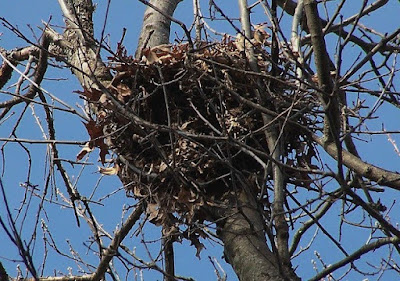
Squirrels' nests (also known as dreys) look like a big pile of leaves caught on a tree branch. In the summer, they may not be much more than that. But winter nests are much more carefully constructed. The squirrels weave together twigs and vines to build a roofed living space. Often, they'll use twigs that still have leaves attached, which starts their outer layer of insulation. Then, they'll add more leaves on the outside. And they line the inside with bark, grass, leaves, and other soft materials -- even animal hair. (Your shedding dog or cat may have done its part to keep a squirrel warm this winter.)
Along with a good fur coat, this multi-layer construction is enough to keep the squirrels safe and warm on most winter nights. For very cold weather, though, squirrels may hold sleepovers, bringing friends into their nest for extra body heat. If you've ever shared a good comforter on a cold night, you know what a difference another body can make. Apparently, so do the squirrels.
This video has great close-up footage of a nest -- and baby squirrels!
Wednesday, December 8, 2010
Identifying Trees in Winter
If making sense of trees seems daunting with the leaves to help you, it can seem downright impossible without them. But if you look closely, there are lots of clues: seed pods, leaf and flower buds, and bark can all help tell one tree from another even in the dead of winter. On Saturday we went out with a hardy crew to see what we could see in Sligo Creek park.
>> Do you have a favorite tree in the winter? Leave a comment below.
Hemlocks are rare in our area, but there happened to be a nice large one planted right by the parking lot where we started on Saturday. Notice the flat needles, growing more or less in a plane off each twig. Their cones are much smaller than a pine cone but similar in shape.
(See our previous post on hemlocks and why they're struggling to survive.)
River birch is also fairly uncommon in our area. When you see it, it will be near water. Or in someone's yard: this tree has really attractive exfoliating bark and a very fine branching structure, made even frillier by catkins hanging off the ends of the twigs.
On our walk, a big river birch was covered in birds including nuthatches, titmice, and a woodpecker. I bet the layers of that bark are a good place to look for insects at this time of year.
One of the most common trees in our area is the tuliptree (or tulip poplar). High up in the winter canopy, the seed clusters are a surefire way to identify this tree. The ground beneath the tree will probably be littered with seeds, as well.
(See also our post about the wonderful flowers that produce these seeds.)
Sycamores also hold their seedpods through the winter: soft little balls of seeds that often attract birds. But what really makes sycamores stand out in our forest canopy is their white branches. Their lower trunks are often covered with exfoliating bark that makes a pattern a lot like army camouflage.
If sycamores are the lightest tree in our forest, black walnuts are the darkest. It's not a perfect test, but often if there's a tree darker than all the others around it, it's a walnut. At this time of year, there may be a few stray nuts hanging on the branches or dropped on the ground to help you identify the tree.
(See also our post on collecting black walnuts in the fall.)
Beeches are another tree with distinctive bark: it's grey and smooth, even when they're quite large. (This has made them the favorite of lovers and graffiti artists throughout the ages.)
Beech trees often hold their leaves into winter, and they have these distinctive leaf buds on the ends of each twig: thin and pointy.
In contrast, ash trees have fat, squat leaf buds, to accommodate their big compound leaves. This can make the twigs look much blunter than the finely tapering branches of other trees.
Ash is one of the few tall trees native to our area that has leaves and branches that grow directly opposite each other. The side branches often curve toward the end of the branch, making a pitchfork shape.
Maples are the other tall trees common to our area that have opposite leaves and branches. Red maples have already set their buds for the tiny flowers that will bloom early in the spring. This gives the twigs a knobby look, even from far away.
(See also our post on maple sap.)

Spicebush has also set its flower buds for next year. The branches of spicebush are not opposite each other on the stem, but the flowers do tend to come in pairs. The surest way to identify spicebush is by smell: scratch and sniff a twig. If it reminds you of something like allspice or nutmeg, it's spicebush.
(See also our posts on spicebush flowers and berries.)
Even in December, we found some wild edibles on our walk as well: oyster mushrooms and dock.
This was our last organized hike for 2010; to get on a mailing list for 2011 send an email to matt@mattshabitats.com.
>> Do you have a favorite tree in the winter? Leave a comment below.
Hemlocks are rare in our area, but there happened to be a nice large one planted right by the parking lot where we started on Saturday. Notice the flat needles, growing more or less in a plane off each twig. Their cones are much smaller than a pine cone but similar in shape.
(See our previous post on hemlocks and why they're struggling to survive.)
River birch is also fairly uncommon in our area. When you see it, it will be near water. Or in someone's yard: this tree has really attractive exfoliating bark and a very fine branching structure, made even frillier by catkins hanging off the ends of the twigs.

On our walk, a big river birch was covered in birds including nuthatches, titmice, and a woodpecker. I bet the layers of that bark are a good place to look for insects at this time of year.
One of the most common trees in our area is the tuliptree (or tulip poplar). High up in the winter canopy, the seed clusters are a surefire way to identify this tree. The ground beneath the tree will probably be littered with seeds, as well.

(See also our post about the wonderful flowers that produce these seeds.)

Sycamores also hold their seedpods through the winter: soft little balls of seeds that often attract birds. But what really makes sycamores stand out in our forest canopy is their white branches. Their lower trunks are often covered with exfoliating bark that makes a pattern a lot like army camouflage.

If sycamores are the lightest tree in our forest, black walnuts are the darkest. It's not a perfect test, but often if there's a tree darker than all the others around it, it's a walnut. At this time of year, there may be a few stray nuts hanging on the branches or dropped on the ground to help you identify the tree.
(See also our post on collecting black walnuts in the fall.)
Beeches are another tree with distinctive bark: it's grey and smooth, even when they're quite large. (This has made them the favorite of lovers and graffiti artists throughout the ages.)

Beech trees often hold their leaves into winter, and they have these distinctive leaf buds on the ends of each twig: thin and pointy.
In contrast, ash trees have fat, squat leaf buds, to accommodate their big compound leaves. This can make the twigs look much blunter than the finely tapering branches of other trees.

Ash is one of the few tall trees native to our area that has leaves and branches that grow directly opposite each other. The side branches often curve toward the end of the branch, making a pitchfork shape.

Maples are the other tall trees common to our area that have opposite leaves and branches. Red maples have already set their buds for the tiny flowers that will bloom early in the spring. This gives the twigs a knobby look, even from far away.
(See also our post on maple sap.)

Spicebush buds by the Natural Capital
Spicebush has also set its flower buds for next year. The branches of spicebush are not opposite each other on the stem, but the flowers do tend to come in pairs. The surest way to identify spicebush is by smell: scratch and sniff a twig. If it reminds you of something like allspice or nutmeg, it's spicebush.
(See also our posts on spicebush flowers and berries.)
Even in December, we found some wild edibles on our walk as well: oyster mushrooms and dock.
This was our last organized hike for 2010; to get on a mailing list for 2011 send an email to matt@mattshabitats.com.
Friday, December 3, 2010
Things to Look For in December
Over at the Jackdaw's Nest, there's a wonderful collection of poems about December. Marge Piercy writes:
Every day we are shortchanged a bit more,
night pressing down on the afternoon
throttling it. Wan sunrise later
and later, every day trimmed
like an old candle you beg to give
an hour's more light.
Here are a few of the things that give our winter a little more light. Links are to last year's posts:
As I get grumpy about cold weather, it's good to remind myself of the junco -- who comes down from Canada to enjoy our (relatively) balmy winter. At least we're not in Canada, I say. Plus, they're cute little birds.
The garlands of greenery went up in my office building this week, just like clockwork. But the tradition of bringing holly inside at this time of year pre-dates Christmas. And there's plenty to celebrate about these berries -- and the birds they attract -- even if you're not decking the halls.
Your breath is often visible around this time of year. Look at it as a measure of temperature and humidity, or enjoy the visible reminder of the breath of all life.
Every day we are shortchanged a bit more,
night pressing down on the afternoon
throttling it. Wan sunrise later
and later, every day trimmed
like an old candle you beg to give
an hour's more light.
Here are a few of the things that give our winter a little more light. Links are to last year's posts:
As I get grumpy about cold weather, it's good to remind myself of the junco -- who comes down from Canada to enjoy our (relatively) balmy winter. At least we're not in Canada, I say. Plus, they're cute little birds.
The garlands of greenery went up in my office building this week, just like clockwork. But the tradition of bringing holly inside at this time of year pre-dates Christmas. And there's plenty to celebrate about these berries -- and the birds they attract -- even if you're not decking the halls.
Your breath is often visible around this time of year. Look at it as a measure of temperature and humidity, or enjoy the visible reminder of the breath of all life.
Thursday, February 4, 2010
LOOK FOR: Juncos, Here For Our Warm Winter
As we look forward to spring with great anticipation, it's good to remember the junco -- who thinks our winters are balmy. Juncos generally breed further north, coming down to the DC area from about October through mid-March to enjoy our milder weather. Based on reports of the bird from Virginia, early taxonomists gave it the Latin name Junco hyemalis, or winter junco. We have to wonder what Canadians think of that.
Actually, Junco hyemalis is more often referred to as the Dark-eyed Junco, perhaps as a nod to our friends in the north. In addition to their dark eyes, juncos have a white belly and a light-colored pinkish beak that stand out against their otherwise slate-grey body. They've also got white in their outer tailfeathers, which you may notice especially when they're in flight. That white gives the junco some camouflage in the snow. They may not need it so much here, but their winter range includes places as cold as the Dakotas -- which still beats spending the winter in northern Saskatchewan.
Wherever they are, juncos generally hang out on the ground -- they even nest on the ground most of the time (though not until they get to their summer homes). Their plumage is well designed for this habitat and often makes them hard to see. So, it can be helpful to keep an ear out for their songs and calls. They make several different trills and chipping noises. Examples of both are here and here.
In the wild: Look on especially on forest floors as you're hiking, but in the winter juncos can also be in fields and roadsides as they forage for food. Keep an eye out for them hopping around and pecking in the leaf litter, or flying into the underbrush to get away from you.
In your yard: About three quarters of a junco's diet comes from seeds. That makes it a good chance that you'll see them at a birdfeeder -- or, even more likely, foraging among the seeds that have spilled onto the ground. Without a birdfeeder, we've seen them foraging on the ground in our yard in the leaf litter, but not very frequently.
Any other tips for spotting juncos? Have you seen any recently? Let us know!

Actually, Junco hyemalis is more often referred to as the Dark-eyed Junco, perhaps as a nod to our friends in the north. In addition to their dark eyes, juncos have a white belly and a light-colored pinkish beak that stand out against their otherwise slate-grey body. They've also got white in their outer tailfeathers, which you may notice especially when they're in flight. That white gives the junco some camouflage in the snow. They may not need it so much here, but their winter range includes places as cold as the Dakotas -- which still beats spending the winter in northern Saskatchewan.
Wherever they are, juncos generally hang out on the ground -- they even nest on the ground most of the time (though not until they get to their summer homes). Their plumage is well designed for this habitat and often makes them hard to see. So, it can be helpful to keep an ear out for their songs and calls. They make several different trills and chipping noises. Examples of both are here and here.

In the wild: Look on especially on forest floors as you're hiking, but in the winter juncos can also be in fields and roadsides as they forage for food. Keep an eye out for them hopping around and pecking in the leaf litter, or flying into the underbrush to get away from you.
In your yard: About three quarters of a junco's diet comes from seeds. That makes it a good chance that you'll see them at a birdfeeder -- or, even more likely, foraging among the seeds that have spilled onto the ground. Without a birdfeeder, we've seen them foraging on the ground in our yard in the leaf litter, but not very frequently.

Any other tips for spotting juncos? Have you seen any recently? Let us know!
Thursday, December 17, 2009
LOOK FOR: Holly, a Symbol in Winter Long Before Christmas
Decking the halls with boughs of holly is a tradition that pre-dates Christmas by quite a while. Romans used holly as a decoration and a gift for Saturnalia, a festival that took place around the winter solstice. Similarly, the Celts would place boughs around their house in the winter for protection and good luck. These traditions were absorbed by the Christian church, and holly became a common Christmas decoration.
Although decorating with holly started as a European tradition, hollies are native to North America as well. Many species are quite different from our classic idea of a holly tree -- some lose their leaves, some have black berries. But Ilex opaca, known as American holly, has the distinctive spiny, evergreen leaves and bright red berries that have been treasured as a winter decoration for millenia. Early colonists noticed them, too, and holly became an entrenched symbol of Christmas in North America.
Holly berries are important food for birds, but poisonous to humans. Birds tend to wait a while into the winter before they start eating them -- repeated freezing and thawing can soften them up and make them more palatable. Meanwhile, we get to enjoy their decoration in the woods. The trees are dioecious -- meaning each tree is either male or female. At this time of year, if you spot a holly without berries, there could be several explanations: 1) it's a male; 2) it's a female without a male nearby; 3) its berries have been completely devoured relatively early in the season, or 4) it doesn't get enough light to set fruit.
In the wild: Ilex opaca is scattered throughout the woods of the Washington, DC region. They can grow up to 40 feet, but it's more common to see shorter trees. Now is a great time to spot them, because the evergreen leaves will stand out when other trees have lost their foliage.
In your yard: Holly is a great addition to a yard: for winter interest, habitat value, and as an evergreen screen. They prefer acidic soil. European and asian species are also sold in nurseries; ask for the native Ilex opaca. Compared to imported species, the native should have the most wildlife value -- although birds will eat the berries of most species, insects that have evolved relationships with the leaves of the native may not be able to survive off imports. And those insects serve as more bird food, throughout the year.
Do you have a favorite spot to find holly? Have you been seeing the birds go after the berries? Leave us a comment!

Although decorating with holly started as a European tradition, hollies are native to North America as well. Many species are quite different from our classic idea of a holly tree -- some lose their leaves, some have black berries. But Ilex opaca, known as American holly, has the distinctive spiny, evergreen leaves and bright red berries that have been treasured as a winter decoration for millenia. Early colonists noticed them, too, and holly became an entrenched symbol of Christmas in North America.
Holly berries are important food for birds, but poisonous to humans. Birds tend to wait a while into the winter before they start eating them -- repeated freezing and thawing can soften them up and make them more palatable. Meanwhile, we get to enjoy their decoration in the woods. The trees are dioecious -- meaning each tree is either male or female. At this time of year, if you spot a holly without berries, there could be several explanations: 1) it's a male; 2) it's a female without a male nearby; 3) its berries have been completely devoured relatively early in the season, or 4) it doesn't get enough light to set fruit.

In the wild: Ilex opaca is scattered throughout the woods of the Washington, DC region. They can grow up to 40 feet, but it's more common to see shorter trees. Now is a great time to spot them, because the evergreen leaves will stand out when other trees have lost their foliage.
In your yard: Holly is a great addition to a yard: for winter interest, habitat value, and as an evergreen screen. They prefer acidic soil. European and asian species are also sold in nurseries; ask for the native Ilex opaca. Compared to imported species, the native should have the most wildlife value -- although birds will eat the berries of most species, insects that have evolved relationships with the leaves of the native may not be able to survive off imports. And those insects serve as more bird food, throughout the year.
Do you have a favorite spot to find holly? Have you been seeing the birds go after the berries? Leave us a comment!
Thursday, December 10, 2009
LOOK FOR: Your Breath
As residents of the DC area know well, warm air can hold more moisture than cold air can -- thus our humid summer days and (relatively) dry winter days. Your breath is warm and moist, just like a 98 degree summer day in DC. When that warm, moist breath hits the much cooler air of winter, the water vapor condenses into tiny water droplets.
There's not a specific temperature at which you can see your breath -- it depends on how much moisture is already in the air. On more humid days, you'll be able to see your breath at a warmer temperature.
Adults often think of seeing our breath as proof of just how miserably cold it is outside. But there are other ways to think of it. Just hang out with kids who still think it's exciting to see their breath (remember?).
Or, take the opportunity to reflect on the way your breath is connected to all other beings on the planet. In The Lost Gospel of the Earth , Tom Hayden writes:

There's not a specific temperature at which you can see your breath -- it depends on how much moisture is already in the air. On more humid days, you'll be able to see your breath at a warmer temperature.
Adults often think of seeing our breath as proof of just how miserably cold it is outside. But there are other ways to think of it. Just hang out with kids who still think it's exciting to see their breath (remember?).
Or, take the opportunity to reflect on the way your breath is connected to all other beings on the planet. In The Lost Gospel of the Earth
, Tom Hayden writes: We are all breathing the same air our ancestors did, the same air as those with whom we think we share nothing in common. We breathe through nature. The air we breathe is generated and maintained by trillions of active organisms, from bacteria and termites to flowers and redwoods. I breathe in oxygen and breathe out carbon dioxide; the trees in my yard give oxygen to us and receive the carbon dioxide...We all breathe individually, but there is only one breathing process going on. When I look at photos of the thin cradle of atmosphere around the planet earth, I am seeing the breath of life.Look for your breath, indeed.
Thursday, December 3, 2009
LOOK FOR: Persimmon, Fruit of the Gods
I have a very early (and not entirely pleasant) childhood memory of getting pelted with persimmons as my mother shook them out of a tree in the woods near our house. Sometime in my twenties I overcame this trauma, and now I am likely to be the one shaking them down. Their scientific name says it all -- Diospyros virginiana, the Virginian food of the gods.
Persimmons have come up with an ingenious method for protecting themselves until they're fully ripe: they are horribly, mouth-puckeringly astringent when immature. There is a common saying (among folks who eat persimmons, at least) that a frost makes persimmons lose this astringency. This is close, but not exactly true: persimmons ripen up around the time of our first frost, but the two events aren't related. We've found edible persimmons before a frost, and horribly astringent ones after frost.
The real rule of thumb is that you only want to eat fruit that are gooey-soft and falling off the tree. Give the trunk a gentle shake and collect the fruits that fall. (Beware any fruit that are still attached to a twig when they fall: they weren't actually ready to come down yet.) Before you eat a whole fruit, take a small bite and wait a minute to make sure it's not going to make your mouth feel like it's been sucked dry: the puckering power of the persimmon is definitely related to how much you've eaten.
But don't let all this talk of astringency scare you off: when they're good, they're really, really good.
At this time of year, you have two ways of identifying a persimmon tree: by bark, and by fruit. The bark is dark grey and chunky, broken up into squares. Learning to recognize it is key, because the fruits are usually well above eye level. When you see the bark, look up: the fruits are round and orange, about the size of a golf ball, hanging on the tree long after it has lost its leaves. Each fruit has a distinctive four-part sepal on top. There's nothing I can think of that you could confuse them with. So, shake away!
In the wild: Persimmons need sun to set a lot of fruit. You'll often see them on the edges of woods. We know of a few on the C&O Canal between Great Falls Tavern and the falls, and many along the Northwest Branch of the Anacostia north of Colesville Road. And we always keep an eye out for fruit along Eastern Avenue at Jecquie Park in Takoma, where there's a tall persimmon right next to the sidewalk.
In your yard: Persimmons can grow in a wide range of soils. You'll need sun, and room for a tree that will eventually be 20 feet or more. Edible Landscaping has a selection of saplings grafted from trees found in the wild with unusually large fruits. They appear to have also grafted them to be self-fertile, which is important, because wild persimmons have male and female trees.
Do you have a persimmon story, or a favorite spot where you find persimmons? Leave us a comment!

Persimmons have come up with an ingenious method for protecting themselves until they're fully ripe: they are horribly, mouth-puckeringly astringent when immature. There is a common saying (among folks who eat persimmons, at least) that a frost makes persimmons lose this astringency. This is close, but not exactly true: persimmons ripen up around the time of our first frost, but the two events aren't related. We've found edible persimmons before a frost, and horribly astringent ones after frost.
The real rule of thumb is that you only want to eat fruit that are gooey-soft and falling off the tree. Give the trunk a gentle shake and collect the fruits that fall. (Beware any fruit that are still attached to a twig when they fall: they weren't actually ready to come down yet.) Before you eat a whole fruit, take a small bite and wait a minute to make sure it's not going to make your mouth feel like it's been sucked dry: the puckering power of the persimmon is definitely related to how much you've eaten.

But don't let all this talk of astringency scare you off: when they're good, they're really, really good.
At this time of year, you have two ways of identifying a persimmon tree: by bark, and by fruit. The bark is dark grey and chunky, broken up into squares. Learning to recognize it is key, because the fruits are usually well above eye level. When you see the bark, look up: the fruits are round and orange, about the size of a golf ball, hanging on the tree long after it has lost its leaves. Each fruit has a distinctive four-part sepal on top. There's nothing I can think of that you could confuse them with. So, shake away!

In the wild: Persimmons need sun to set a lot of fruit. You'll often see them on the edges of woods. We know of a few on the C&O Canal between Great Falls Tavern and the falls, and many along the Northwest Branch of the Anacostia north of Colesville Road. And we always keep an eye out for fruit along Eastern Avenue at Jecquie Park in Takoma, where there's a tall persimmon right next to the sidewalk.
In your yard: Persimmons can grow in a wide range of soils. You'll need sun, and room for a tree that will eventually be 20 feet or more. Edible Landscaping has a selection of saplings grafted from trees found in the wild with unusually large fruits. They appear to have also grafted them to be self-fertile, which is important, because wild persimmons have male and female trees.
Do you have a persimmon story, or a favorite spot where you find persimmons? Leave us a comment!
Subscribe to:
Posts (Atom)