


Last spring was hot and way ahead of schedule, and this spring has been cold and a little slow. Morels, in particular, took forever to show up. We just found some on Wednesday, later in the year than we ever have before. I have a feeling that May will even out to be about normal...so below are all the things we've highlighted before on the Natural Capital in the month of May. It's getting to be a long list!
What else have you been seeing out there? Enjoy the beautiful weekend outdoors and come back and leave us a comment here or on Facebook!
We often make it out to Thomspon Wildlife Management Area in early May to see the trilliums and ladyslipper orchids. I know I usually say that there's so much to see in the DC metro area that roadtrips are unnecessary, but the display at Thompson's is really unbelievable. Last weekend the trilliums were out in Charlottesville so I think they should also be going at Thompson's.
Pinxter Azaleas - Some yards are an absolute riot of hot pinks and purples in the spring with azaleas bred from Asian species. But there is actually an azalea native to this area, and it's quite showy in its own right. They're blooming in Rock Creek Park right now.
Tuliptree Flowers - Tuliptrees are one of the dominant species in the forests in and around Washington, DC. But because the trees are so tall, many people have never seen their flowers. You may find some falling on the ground even if you can't see them in the treetops. (But the real treat is, you can drink their nectar.)
Baltimore Orioles - Migrating right along with the tuliptree nectar are the orioles. Learn to recognize their pretty song and you may greatly improve your chances of actually seeing one. We just saw one for the first time this year on Wednesday, and we knew to look because we heard it first.
Ruby throated hummingbirds - Need I say more? Love, love, love these birds and I'm always so happy to see them come back in the spring. We saw our first one of the season last weekend near Charlottesville, so they're probably around here too -- or will be soon.
There are also many species of migratory warblers -- pretty little songbirds with pretty little songs. In the last several years, we've had a day or two in mid-May when a lot pass through our yard. This post shows some of the species we see the most.
Mountain Laurel - The gnarled, shaggy trunks of mountain laurel (Kalmia latifolia) make it a showy shrub at any time of year. But in late May or early June, they burst into flower.
Tufted titmice - These birds are in the Washington DC area year round, but (like many birds) they're nesting in May. This post was inspired by catching a pair flying back and forth repeatedly to their nest to feed their young.
Blue flag iris - This gorgeous iris can be found in our local wetlands. It's one of the showiest flowers native to the DC region.
Oyster mushrooms - These are quite possibly my favorite local mushroom. They're not showy like chicken of the woods or early like morels, just a reliable, plentiful mushroom with a nice mushroomy flavor.
Putty root orchid - I had been looking for this flower for years. I finally saw one last May.
Serviceberries - We first learned these native, edible fruits as "Juneberries," but we're starting to think they should maybe be called "Mayberries" around here. (Does something already have that name, or is it just a place in tv land?) They should start ripening at the end of the month. They're scattered throughout the woods in the DC area, but you'll get the most fruit from trees that have been planted ornamentally...see our list of some of the best areas we've found, and a few more in the comments to the post.
Eyed click beetles - We love these funky insects and their acrobatics. If you've never seen one in action, check out the videos in our post. For some reason we seem to always see them around this time of year. I'm not sure if that's just chance, or something about their life cycle.
And while you're out looking for all these things, don't forget to start checking for ticks. I've already found one crawling on me this year. Lyme disease is rampant in our area, and a big deal if you get it. But if you find a tick within 24 hours of it attaching itself to you, chances are you won't get Lyme. So just suck it up and look for the little bloodsuckers.
Most Popular Posts
-
Photo credit: ilkerender Last year we listed places to swim near DC and places to rent a canoe near DC . Today we return to complete the s...
-
Summer calls out for being on the water. We've found more than a dozen locations where you can rent a canoe or kayak in the Washington, ...
-
What a lovely break in the heat we're having. Here are some things to keep an eye out for in August. Links are to previous LOOK FOR post...
-
This spring has been cold and a little slow, like last year. Morels , in particular, are just starting to show up. Below are all the things ...
-
The Jack in the pulpits are starting to unfurl right now. I've always loved these flowers, showy in their design rather than their color...
-
I've been distracted from the Natural Capital but I haven't totally forgotten about you guys...Here are some of the other things we ...
-
This time last year, the wood frogs were out and had already laid their eggs. As of this morning, the pond where we always find them was com...
-
Our monthly roundup of things to look for this month: Photo credit: InspiredinDesMoines I originally wrote about bald eagles for t...
-
Two of the things we love best about living in the DC metro area are the public transportation system, and the parks. And so, one of our mai...
-
If I had to name my biggest frustration with the nature around DC, the lack of good swimming holes might top the list. Until 7th grade I liv...
Showing posts with label May. Show all posts
Showing posts with label May. Show all posts
Friday, May 3, 2013


Wednesday, May 23, 2012
LOOK FOR: Eyed Click Beetles, Acrobats of the Bug World
I'm a big fan of eye spots. In the animal world, they're meant to be scary, but to us humans those big "eyes" just make critters look like cartoon babies.
Bug-haters may struggle to join in on my fun, but come on, is this not one cool-looking insect?
Alaus oculatus -- the eyed click beetle or eyed elater -- can be almost 2 inches long. Their true eyes are up by the antennae. Those big spots are just evolution's way of saying, "don't mess with me, I'm either a snake or a really freakin' cool beetle."
But the eye spots are just part of why we love this bug.
Click beetles have a special hinged thorax. And when they're threatened, they bend that hinge to snap a little spine on the bottom of their thorax in and out of a special v-shaped notch. It doesn't just "click" -- it produces enough force to flip the beetle up in the air.
It's a helpful trick when they end up on their backs for some reason.
Like, say, when they happen to be placed on their backs by amused humans.
If you ever happen upon a click beetle, don't be afraid to play with it: they don't sting or bite. Just don't torture the poor things too much!
Amateur videos of quick-jumping beetles are fraught with focusing difficulties, but these two give you an idea of the action:
Eyed click beetle larva hang out in decaying logs and eat other beetle larvae; when we've come across these beetles it's always been in the woods. And, for some reason, we seem to come across them at this particular time of year.
Have you ever seen a click beetle? Where was it?
Bug-haters may struggle to join in on my fun, but come on, is this not one cool-looking insect?
Alaus oculatus -- the eyed click beetle or eyed elater -- can be almost 2 inches long. Their true eyes are up by the antennae. Those big spots are just evolution's way of saying, "don't mess with me, I'm either a snake or a really freakin' cool beetle."
But the eye spots are just part of why we love this bug.

Click beetles have a special hinged thorax. And when they're threatened, they bend that hinge to snap a little spine on the bottom of their thorax in and out of a special v-shaped notch. It doesn't just "click" -- it produces enough force to flip the beetle up in the air.
It's a helpful trick when they end up on their backs for some reason.
Like, say, when they happen to be placed on their backs by amused humans.
If you ever happen upon a click beetle, don't be afraid to play with it: they don't sting or bite. Just don't torture the poor things too much!
Amateur videos of quick-jumping beetles are fraught with focusing difficulties, but these two give you an idea of the action:
Eyed click beetle larva hang out in decaying logs and eat other beetle larvae; when we've come across these beetles it's always been in the woods. And, for some reason, we seem to come across them at this particular time of year.
Have you ever seen a click beetle? Where was it?
Wednesday, May 16, 2012
LOOK FOR: Putty root
For the longest time, this leaf was a mystery to me.
We see it scattered infrequently through forests around the DC metro area in the winter. Always just one leaf.
The pinstripes are pretty noticeable, right? If you know a little botany, you know that the fact that those leaf veins are parallel is significant. It places this plant in the monocot class. What's in that class? Grasses, but this clearly isn't a grass. Onions, daffodils, tulips...pretty sure it's not any of those. Orchids...could it be an orchid?
With a little research we figured out that this must be the leaf of the putty root orchid. A distinguishing characteristic of the putty root is that the leaf dies back before the flowers bloom. As with ramps, you'll see a leaf, or a flower, but almost never both at once.
And so for years we've been saying, oh look, there are the orchid leaves. How nice, that orchids grow here.
If we could just see the orchids. You know, the flower part.
But it turns out that it's a lot easier to see a pinstriped dark green leaf in the middle of winter than it is to see a putty root flower in spring.
These are not the hot pink blooms you might think of when you think "orchid." They're more of a light green edged in a brownish purple...not colors that will catch your eye among the bright colors of spring wildflowers. The flower stalk can be 20 inches tall, but you could walk right by it without noticing.
And so, when I finally saw a putty root in flower, it wasn't because its flowers caught my eye. It was because I stopped to look at a bright yellow flower right next to it.
It took me several seconds to even notice the camouflaged orchid flowers. Then it took me several more seconds to realize what I was looking at.
And then, I looked in the leaves at the base of the flower stalk. And sure enough, even though the leaf was shriveled and brown, those pinstripes stood out. I had found the putty root at last.

We see it scattered infrequently through forests around the DC metro area in the winter. Always just one leaf.
The pinstripes are pretty noticeable, right? If you know a little botany, you know that the fact that those leaf veins are parallel is significant. It places this plant in the monocot class. What's in that class? Grasses, but this clearly isn't a grass. Onions, daffodils, tulips...pretty sure it's not any of those. Orchids...could it be an orchid?
With a little research we figured out that this must be the leaf of the putty root orchid. A distinguishing characteristic of the putty root is that the leaf dies back before the flowers bloom. As with ramps, you'll see a leaf, or a flower, but almost never both at once.
And so for years we've been saying, oh look, there are the orchid leaves. How nice, that orchids grow here.
If we could just see the orchids. You know, the flower part.
But it turns out that it's a lot easier to see a pinstriped dark green leaf in the middle of winter than it is to see a putty root flower in spring.

These are not the hot pink blooms you might think of when you think "orchid." They're more of a light green edged in a brownish purple...not colors that will catch your eye among the bright colors of spring wildflowers. The flower stalk can be 20 inches tall, but you could walk right by it without noticing.
And so, when I finally saw a putty root in flower, it wasn't because its flowers caught my eye. It was because I stopped to look at a bright yellow flower right next to it.
It took me several seconds to even notice the camouflaged orchid flowers. Then it took me several more seconds to realize what I was looking at.
And then, I looked in the leaves at the base of the flower stalk. And sure enough, even though the leaf was shriveled and brown, those pinstripes stood out. I had found the putty root at last.
Wednesday, May 9, 2012
LOOK FOR: Migratory Warblers
In the last 2 years, we've had a bunch of migrating warblers come through our yard in mid-May. In fact, we've noted four of the same species two years in a row. I like to think they remember our little pond as a nice stopping-over point (but I'm sure it's just random).
Have you seen any of these birds lately? I'm keeping an eye out to see if this will be the third year in a row for our backyard guests.
Blackpoll warblerCanada warblerCommon Yellowthroat American RedstartYellow-rumped warblerNorthern WaterthrushFor birdsongs, see the warbler list at the fantastic All About Birds.


Thursday, May 3, 2012
More things to look for in May
At the end of April I posted about several things we were seeing that normally appear in May. Here's the rest of my list of things we've posted on in May -- these usually are later in the month, but who knows when they'll turn up this year.
And there are still many things we haven't gotten to yet...what have you been seeing outside lately? Leave us a comment and tell us what to look out for!
Mountain Laurel - The gnarled, shaggy trunks of mountain laurel (Kalmia latifolia) make it a showy shrub at any time of year. But in late May or early June (mid-May this year?), they burst into flower.
Tufted titmice - These birds are in the Washington DC area year round, but (like many birds) they're nesting in May. This post was inspired by catching a pair flying back and forth repeatedly to their nest to feed their young.
Blue flag iris - This gorgeous iris can be found in our local wetlands. It's one of the showiest flowers native to the DC region.
Oyster mushrooms - These are quite possibly my favorite local mushroom. They're not showy like chicken of the woods or early like morels, just a reliable, plentiful mushroom with a nice mushroomy flavor.
Serviceberries: We first learned these native, edible fruits as "Juneberries," but we're starting to think they should maybe be called "Mayberries" around here. (Does something already have that name, or is it just a place in tv land?) They should start ripening at the end of the month. They're scattered throughout the woods in the DC area, but you'll get the most fruit from trees that have been planted ornamentally...see our list of some of the best areas we've found.
And while you're out looking for all these things, don't forget to start checking for ticks. Lyme disease is rampant in our area, and a big deal if you get it. But if you find a tick within 24 hours of it attaching itself to you, chances are you won't get Lyme. So just suck it up and look for the little bloodsuckers.

Wednesday, April 25, 2012
Things to Look For NOW that Usually Come in May
Even the less nature-aware people that I know are noticing what a weird spring this has been. Topping the list: yesterday, I ate the first ripe strawberry from my garden.
Below are several things we've highlighted before on the Natural Capital well into May, that are blooming/active NOW. Don't miss them!
What else have you been seeing way ahead of time that we shouldn't miss?
We often make it out to Thomspon Wildlife Management Area in early May to see the trilliums and ladyslipper orchids. I know I usually say that there's so much to see in the DC metro area that roadtrips are unnecessary, but the display at Thompson's is really unbelievable. And last night at the Maryland Native Plant Society meeting, someone announced that the trilliums are already blooming.
Pinxter Azaleas - Some yards are an absolute riot of hot pinks and purples in the spring with azaleas bred from Asian species. But there is actually an azalea native to this area, and it's quite showy in its own right. They were already blooming a couple of weeks ago in Rock Creek Park -- hopefully we haven't completely missed them.
Tuliptree Flowers - Tuliptrees are one of the dominant species in the forests in and around Washington, DC. But because the trees are so tall, many people have never seen their flowers. They're blooming now, and you may find some falling on the ground even if you can't see them in the treetops. (But the real treat is, you can drink their nectar.)
Baltimore Orioles - Migrating right along with the tuliptree nectar are the orioles. Learn to recognize their pretty song and you may greatly improve your chances of actually seeing one. We just heard it for the first time this year on Saturday.
Ruby throated hummingbirds - Need I say more? Love, love, love these birds and I'm always so happy to see them come back in the spring. It usually happens in May, but there have been reports of hummingbirds in our area already.
Saturday, May 28, 2011
Where would you spend the end of the world?
Thanks for bearing with a reduced Natural Capital schedule during some crazy 60 hour weeks at my day job.
It's been almost a week since the world didn't end, but I've been thinking about this question ever since last Saturday afternoon, when Matt and I went to go see the mountain laurels blooming at our favorite DC-area mountain laurel location. All through our walk we kept saying, "this would not be a bad way to spend the end of the world." Looking at beautiful flowers together, in one of our favorite places.
Where were you last Saturday on that beautiful spring afternoon? And how would you spend this weekend if you really thought the world was going to end?


Tuesday, May 25, 2010
Trip Report: What's Up on the Northwest Branch?
It's times like these that I really appreciate keeping a nature journal. Months ago, Matt scheduled a hike for the Maryland Native plant society to look at our favorite patch of mountain laurels. And this Saturday, when a big crowd showed up for hike, the bushes were in peak bloom, just as we had hoped. It doesn't always work this way -- a lot of spring flowers were a couple weeks early with all the warm weather we had. But it's views like this -- and the looks on a bunch of seasoned naturalists' faces as they entered a hillside just bursting with flowers -- that make me really appreciate trying to keep track of nature's cycles.

We were on the trail I described last Tuesday as our favorite spot to see mountain laurel. Going at our typical "naturalist's shuffle," we covered less than a mile of the trail, but in that mile we went through a variety of habitats, from river banks to high, dry slopes, and moist woods in between. Here's the list of plants we stopped to look at -- or at least, the ones I managed to write down. (Links are to previous posts on the Natural Capital. )

Flowering
Mountain laurel (Kalmia latifolia)
Cucumber root (Medeola virginiana)
Poison ivy (Toxicodendron radicans)
Blue flag iris (Iris versicolor)
Elderberry (Sambucus racemosa)
Venus' pride (Houstonia purpurea)
Blackberry (Rubus sp.)
With seeds or fruit
Blueberry (Vaccinium sp.)
Huckleberry (Gaylussacia sp.)
Black willow (Salix nigra)
Trailing arbutus (Epigaea repens)
Sweet cicely (Myrrhis odorata)
Rue anemone (Thalictrum thalictroides)

Also noted (most will bloom later this summer)
Black cohosh (Actaea racemosa)
Jewelweed (Impatiens sp.)
Common milkweed (Asclepias syriaca)
Dogbane (Apocynum sp.)
False nettle (Boehmeria cylindrica)
Horse balm (Collinsonia canadensis)
Maple leaf viburnum (Viburnum acerifolium)
Wild yam (Dioscorea villosa)
Dock (Rumex sp.)
Greenbrier (Smilax glauca)
More photos from the walk are on the MNPS Meetup page.
What have you been noticing on the trail lately?

Cindy and Elizabeth in the mountain laurels
We were on the trail I described last Tuesday as our favorite spot to see mountain laurel. Going at our typical "naturalist's shuffle," we covered less than a mile of the trail, but in that mile we went through a variety of habitats, from river banks to high, dry slopes, and moist woods in between. Here's the list of plants we stopped to look at -- or at least, the ones I managed to write down. (Links are to previous posts on the Natural Capital. )
Huckleberries growing under the mountain laurels
Flowering
Mountain laurel (Kalmia latifolia)
Cucumber root (Medeola virginiana)
Poison ivy (Toxicodendron radicans)
Blue flag iris (Iris versicolor)
Elderberry (Sambucus racemosa)
Venus' pride (Houstonia purpurea)
Blackberry (Rubus sp.)
With seeds or fruit
Blueberry (Vaccinium sp.)
Huckleberry (Gaylussacia sp.)
Black willow (Salix nigra)
Trailing arbutus (Epigaea repens)
Sweet cicely (Myrrhis odorata)
Rue anemone (Thalictrum thalictroides)
Poison ivy in flower. Remember: Leaves of three, leave them be!!
Also noted (most will bloom later this summer)
Black cohosh (Actaea racemosa)
Jewelweed (Impatiens sp.)
Common milkweed (Asclepias syriaca)
Dogbane (Apocynum sp.)
False nettle (Boehmeria cylindrica)
Horse balm (Collinsonia canadensis)
Maple leaf viburnum (Viburnum acerifolium)
Wild yam (Dioscorea villosa)
Dock (Rumex sp.)
Greenbrier (Smilax glauca)
More photos from the walk are on the MNPS Meetup page.
What have you been noticing on the trail lately?

Mountain laurel
Thursday, May 20, 2010
LOOK FOR: Blue Flag Iris
The first spring that we moved into our house, I was thrilled to discover an abundance of bearded irises in our front yard. Along with some daffodils and tulips and a crepe myrtle, the irises are among the few non-edible, non-native plants that we've kept, because they're just so pretty. But their place in my heart may soon be usurped by our thriving native blue flag iris, which is blooming right now.

Blue flag iris grows in a different environment, mind you -- it's a wetland plant. There are two species native to this area; we're in the overlapping part of the range of northern blue flag (Iris veriscolor) and southern blue flag (Iris virginica). Both are a little smaller and more delicate feeling than most cultivated irises -- but they've still got the long, spiky leaves and that amazing flower that's impossible to mistake for anything else.
The two native species are hard to tell apart, and I won't bore you with the details. But there is one similar non-native iris you may see growing in wetlands -- yellow flag iris (Iris pseudacorus), which, as you might guess from the name "yellow flag", has bright yellow flowers. It's an import from Asia, and there's some concern that it's displacing blue flag in natural areas. Sure enough, there's been more and more yellow mixed in with the blue flag in our favorite spot over the last several years. We really should talk to someone about getting it out of there.
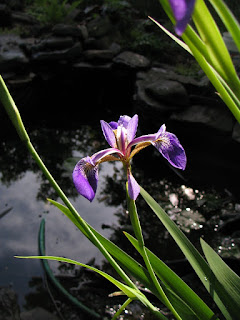
In the wild: We've seen blue flag scattered along the C&O canal here and there, and it's growing at Lake Artemesia. I'm sure there's some at Kenilworth Gardens, and it's worth looking at Huntley Meadows and Jug Bay. Or, if you're heading to look at the mountain laurels along the Northwest Branch of the Anacostia that I wrote about on Tuesday, there's some blue flag across the river. Rather than following the trail on the right hand side of Burnt Mills dam, cross the river (using the sidewalk along Colesville Road), follow the trail upstream on the left hand side, and keep an eye out to your right along the water.
In your yard: We've got a clump of blue flag iris submerged in our pond, and a few more in our rain garden. They seem to do well in both locations. And I love their spiky foliage, even when they're not in bloom!
Blue flag iris on the Northwest Branch
The two native species are hard to tell apart, and I won't bore you with the details. But there is one similar non-native iris you may see growing in wetlands -- yellow flag iris (Iris pseudacorus), which, as you might guess from the name "yellow flag", has bright yellow flowers. It's an import from Asia, and there's some concern that it's displacing blue flag in natural areas. Sure enough, there's been more and more yellow mixed in with the blue flag in our favorite spot over the last several years. We really should talk to someone about getting it out of there.

Blue flag iris in our pond
In your yard: We've got a clump of blue flag iris submerged in our pond, and a few more in our rain garden. They seem to do well in both locations. And I love their spiky foliage, even when they're not in bloom!
Monday, May 17, 2010
What's Your Favorite Spot for Mountain Laurel?
We went to check out the mountain laurel in our favorite spot on Saturday and it's coming on strong -- if this rain doesn't knock off a lot of flowers (and I think it's been gentle enough that it shouldn't) they should be just beautiful this weekend.
So, do you have a favorite spot to go when the mountain laurels are blooming?
I'll tell you ours: the Rachel Carson Trail along the Northwest Branch of the Anacostia. Park at Burnt Mills Dam (or take one of the Z buses from Silver Spring to the Burnt Mills Shopping Center, whose anchor is a Trader Joe's) and head upstream -- from the dam it's less than half a mile to a hillside that is covered in blooming mountain laurels right now.
Click on the map for driving directions, or check WMATA for the schedules of the Z buses and some RideOn buses that also go by this spot (you're aiming for 10765 Colesville Road).
View Burnt Mills Dam in a larger map
This may be a ways out if you're coming from points further south -- so tell us, what's your favorite spot for mountain laurel?
Thursday, May 13, 2010
LOOK FOR: Oyster Mushrooms
They're not as sexy as morels, nor as predictable, but oyster mushrooms -- Pleurotus ostreatus -- might just be my favorite wild mushroom. And I don't even like oysters.
 We find oyster mushrooms spring through fall here in the DC area, but they are whitest (and therefore most eye-catching) in the spring and summer. They grow on dead or dying wood, usually on logs that still have their bark. Young caps are about 2 inches across but they can get as wide as 8 inches -- at which point they're a little rubbery for eating.
The stalks of oyster mushrooms are very short, and they don't come out of the middle of the caps. Instead, the stem is off to the side, allowing the mushrooms to grow in overlapping clusters. In fact, their genus name, Pleurotus, comes from the Greek word for side. (And I always thought it was related to the French word for rain!)

But one of the most distinguishing characteristics of oyster mushrooms is not a part of the mushroom itself -- it's a little black beetle that we absolutely always find between the gills. They're actually part of a group of beetles known as the Pleasing Fungus Beetles. Triplax lay their eggs on oyster mushrooms, and spend the rest of their lives hanging out among the gills and slowly eating them. They're harmless and easy enough to wash off, and a great identification aid.
Which is important, because there are other similar white mushrooms that grow on wood. They probably won't kill you, but they're supposed to taste awful. Luckily, oyster mushrooms are frequently available at farmers' markets and at high-end grocery stores. You can stop there, or you can use cultivated mushrooms to get a good sense of what they're like there before you go out looking for them (though the ones you see in the store will be relatively dried up after several days of storage, and some farmers select for more colorful strains). Your absolute best bet for safely identifying wild mushrooms is to out with experienced mushroomers, like the ones at the Mycological Association of Washington. (We sometimes find mushrooms on our wild food walks as well.)
 In the wild: Like many mushrooms, oysters like shade, and they clearly respond to rain -- you'll often see them a day or two after a good soaking. Keep an eye out when you pass downed logs. Once you do find some, they'll come back in the same location repeatedly.
In your yard (or apartment): Oyster mushrooms can be cultivated on many different substrates that contain cellulose -- not just logs but also shredded paper, coffee grounds, or sawdust. There are even kits using rolls of toilet paper as the base, designed to grow indoors. If you want to give it a try, check out the products at Field & Forest or Fungi Perfecti.
Photo credit: The Natural Capital
The stalks of oyster mushrooms are very short, and they don't come out of the middle of the caps. Instead, the stem is off to the side, allowing the mushrooms to grow in overlapping clusters. In fact, their genus name, Pleurotus, comes from the Greek word for side. (And I always thought it was related to the French word for rain!)
Oyster mushroom with fungus beetle by the Natural Capital
Which is important, because there are other similar white mushrooms that grow on wood. They probably won't kill you, but they're supposed to taste awful. Luckily, oyster mushrooms are frequently available at farmers' markets and at high-end grocery stores. You can stop there, or you can use cultivated mushrooms to get a good sense of what they're like there before you go out looking for them (though the ones you see in the store will be relatively dried up after several days of storage, and some farmers select for more colorful strains). Your absolute best bet for safely identifying wild mushrooms is to out with experienced mushroomers, like the ones at the Mycological Association of Washington. (We sometimes find mushrooms on our wild food walks as well.)
Photo credit: Mr Snootyhamper
In your yard (or apartment): Oyster mushrooms can be cultivated on many different substrates that contain cellulose -- not just logs but also shredded paper, coffee grounds, or sawdust. There are even kits using rolls of toilet paper as the base, designed to grow indoors. If you want to give it a try, check out the products at Field & Forest or Fungi Perfecti.
Subscribe to:
Posts (Atom)