Most Popular Posts

Showing posts with label February. Show all posts

Friday, February 24, 2012

LOOK FOR: Maple Flowers

Maples are one of the earliest trees to bloom in our area -- a sure sign of spring. But not many people see them...they're up high, and they're not super-showy. When the light hits it right, though, the entire crown of a maple tree in flower will light up in red or yellow. So, as you're walking around this week, look up for something like this:

Maple Flowers
Photo credit: jpwbee

Maple flowers are insect-pollinated, and an important early-season source of food for insects. As the weather warms up enough for the bees and other pollinators to get active, there's not a lot else going on for them besides the maples.

Spring delicacy
Photo credit: Anita363
Squirrels also like to feast on the flowers. For the last several mornings, we've been watching them go to town on our neighbor's silver maple, hanging upside down to get to the last flowers on the end of a branch.

The maples can take it -- they bloom so profusely, the squirrels hardly make a dent. Each one of the female flowers that gets pollinated will form one of those helicopter-like seed pods (technically, samaras) that fall down in the spring. Many years, our neighbor's samaras carpet our yard. The squirrels eat those too. And then what seems like a million baby maple trees still come up from the leftovers.

(Apparently I might not be exaggerating -- the Forest Service says a 12-inch diameter red maple can produce a million seeds. And our neighbor's tree is probably 3 times that wide.)

Red Maple Flowers

Photo credit: BlueRidgeKitties
You'll see I said female flowers produce the seeds -- maples have flowers that are either male or female.

The male flowers are a little fluffier looking, due to all their pollen-producing stamens.

Female flowers are a little more sedate, waiting for that pollen to come their way. But they still have their own frills.

Plant geek bonus points: Many maple trees have only male or only female flowers. Some have both male and female flowers -- but usually on different branches. If you come across a maple tree with accessible branches, can you tell whether it's male, female, or monoecious?

The rest of us will just appreciate the fact that there are flowers to look at this early in the year.

Wednesday, February 16, 2011

Forcing Flowers

The hedge between our yard and our neighbor's yard includes a long stretch of forsythia. Every January, we cut a vase full of bare branches and stick them in our kitchen.

Gradually, those bare branches are transformed as the buds swell and then explode into a riot of yellow blooms -- several weeks before the branches outside bloom. It's a sure pick-me-up in the middle of the end-of-winter doldrums.

Want to give it a try? Keep in mind that you're basically pruning your tree or shrub -- don't cut too many branches from any one plant, and work for symmetry. And (this should go without saying, but I'll say it anyway) stick to trees in yards -- don't go hacking up the forest.

Other blooming trees that you could try forcing include maple, dogwood, redbud, spicebush, and cherry.

See if you can beat the spring -- or at least bring a little spring indoors!

Friday, February 11, 2011

LOOK FOR: Vultures (They Make Better Valentines than Teddy Bears)

Black vulture Great falls,  Maryland, USA
Vultures at Great Falls by badjoby
I'm willing to bet the vast majority of you have either given or received a teddy bear on Valentine's Day at some point in your life. It's part of what we do. But I am here to speak truth to the power of the Valentine-industrial complex: vultures would make better valentines than bears. (If you value monogamy and shared child-raising, that is.)

If you're looking for a life partner, a bear is not a good role model. Bears spend the summer mating season hooking up -- both males and females may have multiple partners even within the same season. Then the females are on their own to raise their young. Different cubs in the same litter may have different fathers, but it doesn't really matter, because none of those dads will be around to help raise them.

Vultures, on the other hand, mate for life. When it's time to raise young, both parents help incubate the eggs and feed the babies. And they do it with the same partner, over and over again.

Which is the message you'd like to send to your partner this Valentines Day?  
  1. Baby, you're cute, but when you start gaining weight with your first pregnancy I'll go out hunting one day and never come back.
  2. I know you're going to grow old and wrinkly, but I want to grow old and wrinkly with you.
Vulture Chick
Photo credit: whiteoakart
Despite this winningly romantic message, I'm not seeing a big future in vulture stuffed animals, though Disney has tried. Maybe they'd have better luck if they focused on vulture chicks -- they are quite fluffy.

When you're out on a walk to a romantic spot this weekend, you're likely to see vultures circling above in the thermal currents. Impress your date by knowing the difference between our two native vulture species, even when they're high above:
  • Black vultures' wings are mostly black, with lighter feathers just at the tips. They hold them in a flat line, and may flap them quickly.
  • Turkey vultures, on the other hand, have a light stripe across the bottom of their wings and tail. They hold their wings in more of a v-shape, and they flap less and more slowly.


Black vulture (on left) by Jerry Oldnettel
Turkey vulture (on right) by Larry Meade
Up close, black vultures have black heads. Turkey vultures have red heads. Some say it looks like a turkey head; some say the red blends in with the carrion they like to eat.

But when you see them up there, don't just think, there's a bird that spends its entire life eating rotting flesh. Now you can think, there's a bird that spends its entire life eating rotting flesh and raising its young in a monogamous pair bond.

How romantic.

Wednesday, February 9, 2011

What's the Most Romantic Outdoor Spot in the DC Area?

Inside a Seed
Photo credit: Phoney Nickle
Let's say, hypothetically, I wanted to go for a hike with my honey on Valentine's Day. What's the most romantic spot I could go to, in your opinion?

Do you go for the sweeping vistas, or the secluded spots that noone knows about?

Or maybe there's a spot that's special to you and your partner for a particular reason?

Tell us about it.

Friday, February 4, 2011

Things to Look For in February

Eastern skunk cabbage
Skunk cabbage by Colin Purrington
Skunk cabbage is one of the select group of plants in the world that attracts pollinators by imitating rotting flesh. And, it's just about the only native flower you're going to find blooming at this time of year.

I like to think of maple syrup as the taste of trees waking up in the spring. They've been storing energy all winter as starch in their wood. But now, they want to use it to start producing leaves. And the way they get that energy to their leaves? Sap. Which we collect, and boil down, and eat on our pancakes.
Elizabeth sledding
Elizabeth sledding, by Matt
Remember all that snow we had last February? Did you know that out of the top ten 3-day snowfall totals in DC, seven have been in February? We'll see what this month has in store for us...
What have you been noticing in nature lately? Leave us a comment!

Friday, January 21, 2011

LOOK FOR: Footprints in the Snow

Winter is the time of year here in the mid-Atlantic where things become more visible: the lay of the land, the structures of the trees, and the tracks of mammals and birds.


Fox tracks crossing the Northwest Branch
When I was a kid, we had invisible markers that we could use to write a secret message a piece of paper. The only way to reveal the message was using another special marker that when you drew over what was scribbled, the message became visible.

A light coat of snow accomplishes a similar phenomenon. All around us, creatures are moving about making invisible marks. Many are secretive, shying away from humans or making their rounds in the early morning. When I take a walk in the woods, I have no clue that a fox uses the same path during its early morning hunts. But, the snow reveals it all. You can even tell when the fox was walking, trotting, or running by the pattern its prints leave in the snow.

So, get out before the snow gets too trampled and follow a trail. All will be revealed!

Here are some different tracks that you may encounter in the snow. Once you learn them, you can find them year-round in muddy areas along streams or puddles.

Tuesday, December 14, 2010

A Southerner's Guide to Staying Warm Outdoors in Winter

DC is in a funny middle ground, geographically speaking. Is it the northern edge of the south, or the southern edge of the north? Having spent good chunks of my life in much warmer climes, DC is about as far north as I'm willing to live. I'm just not a big fan of cold weather. (If DC is as far south as you're willing to live, this post might not be for you.)

I am a big fan of being outdoors, so I try not to let the cold keep me inside all winter. Every year as the thermometer takes a nose-dive I have to remind myself of all the coping strategies I've come up with:

>> Do you have tricks for staying warm outside? Leave a comment below.

Sugar Plum Snowflake
Photo credit: CaptPiper
Stay dry. Moisture is a killer in cold temperatures. This is the number one rule, underlying several of the others on this list.

Removable layers on top. If I'm going to be moving around, I know I'll stay drier (and therefore possibly even warmer) if I can easily take off a layer once I warm up.

Long johns on the bottom. My discovery of long underwear after leaving Florida for college changed my experience of winter from agony to a reluctant truce. I've got three different weights (silk, polypro, and fleece) so I can aim for just the right level of insulation. For me, this is a below-the-waist solution: most long john tops actually make me too hot.

Learn to live with hat-head. Every day I cringe on my way to the metro when I see people walking around without a hat in this weather. How do they do it? Mom was only partially right: it turns out your head is no more efficient than any other exposed part of your body at losing heat. But if it's the only part of your body that's uncovered, you'll lose a lot of heat that way. And your head is more sensitive to cold than other body parts. I'd rather go with a hat and lighter clothing than the other way around.

Matt in the snowy forest
Photo credit: The Natural Capital
Mittens are warmer than gloves. Somehow, pooling the body heat from all four digits makes a huge difference. This is another item I have to take off once I get moving. But it's so nice on a cold winter day to have warm hands!

Europeans know how to tie a scarf. You do wear a scarf, don't you? I just learned this trick last year: fold your scarf in half, put the folded scarf around your neck, then tuck the loose ends through the fold. This is much warmer than just wrapping: it seems to stay a lot snugger on my neck.

Keep moving. Inside your layers, you'll generate a good amount of heat if you keep moving. But there's a corrollary that goes back to rule #1: don't get all sweaty.

Adjust your attitude. I'll admit it: this is the hardest one for me. But if I go outside expecting to be miserable, there's a much better chance that I'll be miserable. There's always something beautiful in nature to be discovered, even on the coldest day. But you have to go outside to find it!

How do you stay warm in winter? Leave us a comment below.

Soaring
Photo credit: gfpeck

Friday, March 5, 2010

LOOK FOR: Yellow-Bellied Sapsuckers

yellow bellied sapsucker on tree
Photo credit: Beth Fishkind
As we get all excited about the sap running, so do other critters. Perhaps first among them is the yellow-bellied sapsucker, who winters in the south. Around now, the sapsuckers start migrating north, following this rich food source as each successive latitude warms up enough to start the flow.

Sapsuckers make a series of round holes in a tree's bark, usually lined up in efficient little rows. They then lap up the sap that comes out -- sometimes returning to holes over and over as the sap continues to ooze.

In addition to their their distinctive holes, sapsuckers are a distinctive-looking bird. Like other woodpeckers, they've got mottled black and whitish feathers on their back and wings. Both males and females have a red spot on the top of their head; males also have a red throat. The belly has just a hint of yellow that you won't be able to detect without exactly the right light -- the picture above may be the yellowest I've ever seen.

yellow-bellied sapsucker and holes
Photo credit: New Jersey Birds
The yellow-bellied sapsucker is considered a "keystone" species by some ecologists because many other birds rely on them. It's a hard time of year to find food, and other species -- including kinglets, warblers, phoebes, and even hummingbirds -- will follow behind the sapsuckers to lap up sap or insects.

But sapsuckers don't subsist entirely on sugar -- good thing, because the sap doesn't flow all year.  The sapsucker may also make rectangular holes that allow them to get to the tree's phloem, which they eat. And, like other woodpeckers, they eat a lot of insects. Even when the sap is running, many insects either get uncovered by drilling into the tree, or are themselves attracted to the sap.

But no other woodpecker in our area makes such systematic holes in the trees. If you see a tidy little row, it was probably a sapsucker.

sapsucker holes
Photo credit: we'moon in the woods
In the wild: You can find sapsuckers throughout the open woods of our region. If you see some holes actively oozing sap, hang out quietly for a little while and see who comes by.

In your yard: Don't worry, sapsuckers generally do not cause serious damage to trees -- the wounds they make are pretty shallow. Sapsuckers come to the large oak tree in our backyard all the time, and it's going strong.

We read of one photographer who attracted sapsuckers to his yard by drilling holes in an upright log and filling them with corn syrup. Cheating? You decide. It must have been quite a sugar rush for the birds!

Have you seen sapsuckers lately? Let us know.


Like the photos in this post? Mouse over for credits; a click takes you to the photographer on Flickr.

Friday, February 26, 2010

LOOK FOR: Skunk Cabbage, First Flower of the Year

If you are afflicted with melancholy at this season, go to the swamp and see the brave spears of skunk-cabbage buds already advanced toward a new year...There is no can’t nor cant to them. They see over the brow of winter’s hill. They see another summer ahead.  -- Henry David Thoreau

skunk cabbage spadix inside the spathe
Photo credit: gareandkitty
So much of the diversity in the natural world is the result of plants and animals figuring out how to survive in territory where others can't. A few weeks ago, we talked about rock tripe and how it manages to pluck enough moisture and nutrients from the air that it can colonize rock surfaces. Today, we bring you skunk cabbage -- which not only survives in a wetland environment many plants find inhospitable, but manages to attract pollinators in late winter, when nothing else is flowering.

To attract those pollinators, skunk cabbage relies more on guile than on charm. The skunk cabbage flower is no sweet-smelling bull's eye like most of the flowers we'll see later in the year. In fact, it stinks. Somehow, this plant has figured out how to make the molecules cadaverine (normally put off by rotting flesh) and skatole (otherwise found in scat). And with them, it attracts flies and beetles seeking a meal.

skunk cabbage spathes
Photo credit: cyanocorax
The flowers continue their deception with a streaky reddish-purple spathe (the hood-shaped bract around the flowers) that is not unlike the color of carrion these insects are seeking. Inside that hood is a spadix made up of dozens of flowers, which get inadvertently pollinated by insects seeking a stinky bite to eat.

And skunk cabbage has one more trick up its sleeve (or should we say, spathe). Amazingly, it produces its own heat -- it may be 50 degrees or more above the ambient air temperature when the female flowers are in full bloom. This brings in more insects. For one thing, the warmth makes the stinky carrion smells more volatile. And insects might expect a piece of carrion to be warm, because of the heat released by the bacteria that are breaking it down.

skunk cabbage in snow
Photo credit: Hljod.Huskona
But some insects just seem to want a little vacation from winter, like the rest of us do. Skunk cabbage can be warm enough to melt snow and ice, which surely feels good to insects trying to make a living at this time of year. The flowering season for skunk cabbage can vary by the weather, but in the Washington DC area they can start flowering in January and may go as late as March.

So, if you've been feeling the melancholy of the season, or having trouble seeing the summer ahead...it's a great time to start looking for flowers.

In the Swamp
Photo credit: RupertG
In the wild: Skunk cabbage tends to grow in relatively flat areas that stay wet or muddy for most of the year. Look along small streams and seeps -- perhaps even growing in shallow water. There are many patches of skunk cabbage in Rock Creek Park and lots of other local parks. You may have noticed it in the summer with its large clumps of 2-foot-long leaves growing close to the ground. Right now you won't see much hint of the leaves -- you're just looking for the purplish spathes poking up from the ground.

In your yard: You won't have much luck growing skunk cabbage unless you've got a wetland in your backyard. If you do, go for it -- skunk cabbage are deer resistant, and that foliage is hard to beat.

Thursday, February 18, 2010

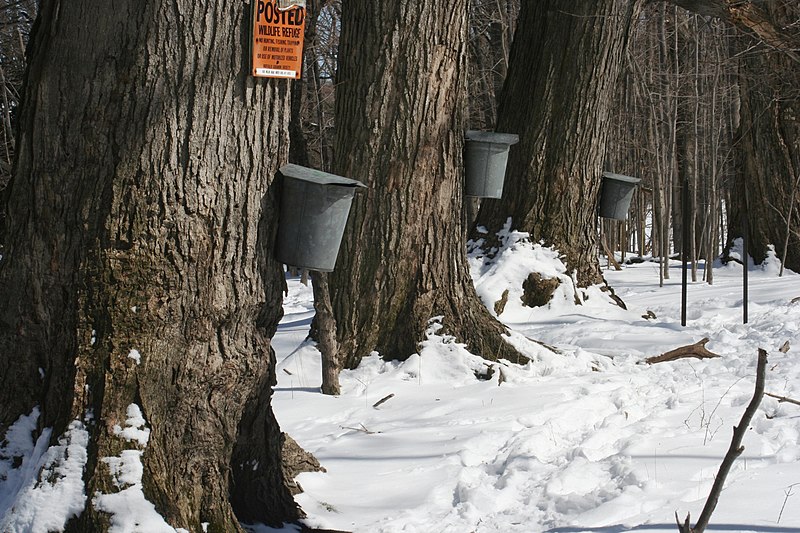
LOOK FOR: Maple Sap (and Pancakes)

Photo credit: Dave Pape
Every spring, as temperatures rise, trees start to wake up from their dormancy. They've been storing energy  all winter as starch in their wood. But now, they want to use it to start producing leaves. And the way they get that energy to their leaves? Sap.

There's a particular window of opportunity for maple sap that is determined by temperature. When the temperature of the wood rises to the mid-30s, enzymes start to convert the stored starch into sugar. And once the tree warms up to about 45 degrees, the starch stops converting into sugar. In between, when days are relatively warm but the nights are relatively cold, pressure builds up in the tree, and the sap comes pouring out of any wounds -- particularly a wound that was put there intentionally to direct that sap into a bucket.

tasting maple sap from the spile
Photo credit: Friends Central School
If you taste the sap when it comes out of a tree, it will be only very slightly sweet; the sap is usually less than 3 percent sugar. In contrast, maple syrup is typically around 66 percent sugar. To get from 3 to 66 percent, you have to boil off an enormous amount of water. A single tap may release 10 to 20 gallons of sap from a tree over the several weeks that the sap is running. But that 20 gallons of sap boils down to less than a gallon of syrup. No wonder it's so expensive!

maple sap bucket
Photo credit: Lolly Knit
Several local parks have demonstrations of making maple syrup -- check out the calendars at Brookside Nature Center in Wheaton and Colvin Run Mill in Great Falls.

Meanwhile, we'll be curled up by our woodburning stove, watching a little pot of sap collected from our neighborhood maples as it slowly cooks down...the sweet taste of spring on its way!

Do you have any maple syrup stories to share? Leave us a comment.

Thursday, February 4, 2010

LOOK FOR: Juncos, Here For Our Warm Winter

junco
Photo credit: ehpien
As we look forward to spring with great anticipation, it's good to remember the junco -- who thinks our winters are balmy. Juncos generally breed further north, coming down to the DC area from about October through mid-March to enjoy our milder weather. Based on reports of the bird from Virginia, early taxonomists gave it the Latin name Junco hyemalis, or winter junco. We have to wonder what Canadians think of that.

Actually, Junco hyemalis is more often referred to as the Dark-eyed Junco, perhaps as a nod to our friends in the north. In addition to their dark eyes, juncos have a white belly and a light-colored pinkish beak that stand out against their otherwise slate-grey body.  They've also got white in their outer tailfeathers, which you may notice especially when they're in flight. That white gives the junco some camouflage in the snow. They may not need it so much here, but their winter range includes places as cold as the Dakotas -- which still beats spending the winter in northern Saskatchewan.

juncos in snow
Photo credit: badjoby
Wherever they are, juncos generally hang out on the ground -- they even nest on the ground most of the time (though not until they get to their summer homes). Their plumage is well designed for this habitat and often makes them hard to see. So, it can be helpful to keep an ear out for their songs and calls. They make several different trills and chipping noises. Examples of both are here and here.

In the wild: Look on especially on forest floors as you're hiking, but in the winter juncos can also be in fields and roadsides as they forage for food. Keep an eye out for them hopping around and pecking in the leaf litter, or flying into the underbrush to get away from you.

Photo credit: Jason Means
In your yard: About three quarters of a junco's diet comes from seeds. That makes it a good chance that you'll see them at a birdfeeder -- or, even more likely, foraging among the seeds that have spilled onto the ground. Without a birdfeeder, we've seen them foraging on the ground in our yard in the leaf litter, but not very frequently.

Any other tips for spotting juncos? Have you seen any recently? Let us know!

Wednesday, February 3, 2010

Snow!

We interrupt our regularly scheduled programming to bring you some pictures we took this morning along the Northwest Branch Trail off Colesville Road. It was such a treat to be out there early -- there was only one other set of human footprints, but lots of fox, deer, and rabbit tracks. In fact, Matt managed to see a rabbit before it hopped away from us.

Have you been having your own snow-based adventures? We'd love to hear about them!

Frozen NW Branch

NW Branch

river birch by NW branch

creek

beaver dam